Tampilkan postingan dengan label religion. Tampilkan semua postingan

Rabu, September 16, 2009

Islam Culture

Islam is the second largest religion in the world. Only Christianity has more followers. People who follow the religion of Islam are called Muslims. Today, almost 1 billion people call themselves Muslims. Most Muslims live in a string of countries that extends from Morocco in North Africa to Indonesia in Southeast Asia.

BIRTH OF ISLAM

An Arab trader named Muhammad was the founding prophet of Islam. He lived in Mecca, a busy trading town in Arabia (now called Saudi Arabia). Mecca had temples built to honor various pagan gods. Pilgrims visited these temples to worship statues of the gods. One day, while fasting in a cave, Muhammad had a vision. He returned to Mecca to preach a new religious message. He said there is only one god, not many, and no one should worship idols (statues of gods). He called on the people of Mecca to surrender themselves to Allah, as he called God.

ISLAM GAINS POWER

Muhammad’s message angered some Meccans. In the year 622, they forced him to flee to another city, now known as Medina. That journey—or Hegira, as Muslims call it—marks the beginning of the Islamic calendar. In Medina, Muhammad became the head of the community. Soon, he led his Muslim followers back to Mecca. After a battle, the Meccans accepted Islam. Within a century, Muslims ruled an empire that stretched from India to Spain. Throughout this empire, Islam took root. The empire crumbled after a few centuries, but many people of these lands remained Muslims.

ISLAM DIVIDES

After Muhammad’s death in 632, Muslims disagreed about how the next leader should be chosen. One group came to be known as Sunnis and the other as Shias. Islam remains divided into these two branches.

By the year 900, a Muslim movement called Sufism had developed. Sufis seek a personal experience of God. Many great Muslim poets have been Sufis. Sufis helped to spread Islam long after the Islamic empire crumbled.

WHAT DO MUSLIMS BELIEVE?

The Muslim faith centers on five beliefs and practices. These are known as the five pillars of Islam. According to the five pillars, Muslims must

Accept that only one God exists and Muhammad was his messenger.
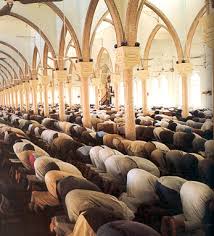
Perform certain prayers five times a day.
Fast from dawn to dusk during a month called Ramadan.
Give a portion of their wealth to the poor.
Visit Mecca at least once if they are able to.

These practices are based on the holy book of Islam, the Qur’an (also spelled Koran). Muslims believe that the Qur’an is the word of God, delivered through Muhammad. Muslim practices are also based on the Hadith—Muhammad’s own deeds and sayings as reported by his companions.

ISLAMIC LAWS AND CUSTOMS

In the early Islamic empire, the government and the religion were the same. All questions that came up were decided by religious scholars. Their decisions filled in a set of laws called the Sharia. These laws, which are also drawn from the Qur’an and Hadith, cover every aspect of life. They tell what crimes should be punished and how. They set the rules for marriage, contracts, and inheritance.
Islam is thus a complete way of life. In this way of life, men and women generally have different roles. Their activities are often kept quite separated. Families sometimes arrange marriages. Women are expected to be well covered when they go outdoors. In some countries, they have to wear a veil covering their body. In Arab countries, such a covering is called a burka.The mosque is the traditional place of worship for Muslims. Friday is their holy day, or day of worship. Islam teaches that all Muslims are equal before God. This teaching gives Muslims around the world a sense of community, no matter what country or social class they come from.
Read rest of entry Bookmark and Share

Buddhism

Can you imagine wanting nothing? How would you feel? Calm and relaxed? Cheerful? Satisfied? This is the state of mind Buddhists try to reach. Buddhism is both a religion and a philosophy. It was founded in the 6th century bc by a man known as Buddha.

WHO WAS BUDDHA?

Siddhartha Gautama, who later became known as Buddha, was born in Nepal around 563 bc. His father was a king. Young Siddhartha grew up knowing only comfort and pleasure. Then one day he discovered that suffering exists, and it troubled him. Why did people suffer, he wondered? How could they be saved?

Siddhartha went on a quest for answers. Holy men advised him that giving up all pleasures and comforts would release him from suffering. Siddhartha tried this, but it didn’t work. Finally, he sat under a bo tree and meditated—that is, he emptied his mind of all thoughts in an effort to concentrate. Gradually, he came to enlightenment, awareness of the religious truth he had been seeking. He was then known as Buddha. Buddha means the “enlightened one.”

WHAT DID BUDDHA TEACH?

Buddha taught that happiness lies neither in pleasure nor in self-denial. He advised people to follow a middle way between extremes. He preached what he called the Four Noble Truths: first, that life is suffering; second, that suffering comes from desire, or attachment to the world; third, that attachment can be ended; and fourth, that the way to end it is to follow the Eightfold Path.

The Eightfold Path consists of eight things people should do or have in their lives. They include right views, right intention, right speech, right action, right effort, right-mindedness, and making a living in the right way. The eighth step is daily meditation. Buddha said people who follow this path can achieve a state of happiness called nirvana. As a result, they escape the world and its suffering forever. Those who do not achieve nirvana are going to be born again after death in another form and will have to start over.

HOW DID BUDDHISM GROW AND CHANGE?

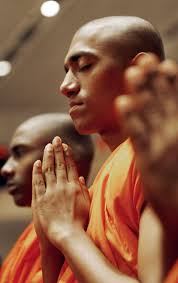
Buddha’s followers were monks. They lived apart from the world, in monasteries. They shaved their heads, wore orange robes, and lived a Buddhist life.

About a hundred years after Buddha died, his followers started writing his teachings down in books called sutras. Soon after this, Buddhism split into two branches. The Theravada Buddhists believe each person should strive to reach nirvana on his or her own. The Mahayana Buddhists believe Buddhists should seek help from bodhisattvas. A bodhisattva is someone who has already reached enlightenment.

HOW DID BUDDHISM SPREAD?

In the 3rd century bc, an Indian king named Ashoka became a Buddhist. He sent Buddhist teachers far and wide. Buddhism spread over the next 500 years. It took root in China, Korea, Japan, Southeast Asia, and Sri Lanka.
As it spread, Buddhism took new forms. Buddhists of Tibet regard their leader, the Dalai Lama, as a living Buddha. In Japan, Zen Buddhists emphasize meditation and work.Most Buddhists today live in East Asia and Sri Lanka. Buddhism is also finding new followers in India, where it had once died out. Buddhists can now be found all around the world,including in the United States and Canada.
Read rest of entry Bookmark and Share
 

Info blog

Add to Technorati Favorites Art Blogs - Blog Catalog Blog Directory negative effects television Motives Media - Technology Blogs - Iconoclock.com - Polaris Print

Twitter Update

Technology news | Computer, Internet, and Blogging Information Copyright © 2009 FreshBrown is Designed by Simran